Humans Meet Tech · Interview
When Technology Automates Exclusion, and Why It Can’t Fix a Broken System
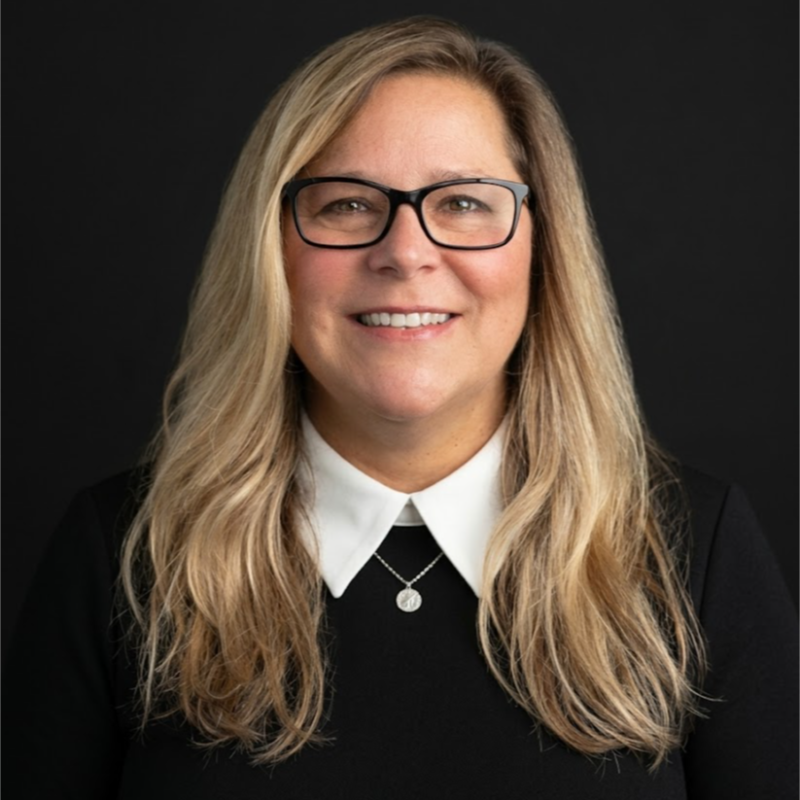
Felicia Nurmsen spent more than twenty-five years helping organizations build workplaces that work for more people, then stopped advising and started building. Her work points at something leaders consistently get backwards: a tool inherits whatever process it is dropped into. If that process quietly excludes people, the tool doesn’t repair it. It gives that process reach.
With Felicia Nurmsen, Founder of Inclusion Without Illusion & Alterita. Disability inclusion · AI governance · Hiring and screening.
Listen to the conversation
Humans Meet Tech · Felicia Nurmsen · Full episode
She could see her colleague talking. She couldn’t hear a single word. Felicia Nurmsen leaned across the conference table, apologized, and the woman had to stand up and walk around to the other side to be heard. That moment happened to one of the most experienced people in the field it belongs to.
Nurmsen has spent nearly a decade shaping the National Disability Inclusion Strategy at the National Organization on Disability. She audited the pre-hire process at Foot Locker’s biggest distribution center and watched the company adopt her recommendations. She walked Toyota Motor North America through a review that changed what got built into a new site. Then she stopped advising and started building. She runs Inclusion Without Illusion, and she founded Alterita, whose Accompli+ platform repairs the accommodation process itself rather than publishing another guide about it.
A tool inherits whatever process it is dropped into. If that process is unclear, inconsistent, or quietly excluding people, the tool doesn’t repair it. It gives that process reach.
The technology was never the hardest part
Nurmsen knew for years she was losing her hearing. She put it off anyway, and she’s unsparing about why: vanity, partly, and ageism she was aiming at herself, mostly. So she compensated. She concentrated harder. She watched faces. She asked people to repeat themselves until she ran out of room to keep asking.
There’s only so many times that you can say it, until you’re really not fully participating. You’re not hearing. You’re not really engaging with anyone.
The technology had been available the whole time. What kept her from it was stigma and her own reluctance, which is why she frames the lesson as one about awareness rather than equipment. A tool can be technically available and practically out of reach, and people keep compensating long after leadership has recorded the problem as solved.
Accommodation shouldn’t feel like an investigation
Her own first attempt to request a workplace accommodation is the reason Accompli+ exists. “Horrible is probably the best case scenario,” she says. “Dehumanizing really was my experience.” She has been collecting versions of that story for twenty-five years, and says almost every one has been a bad one: repeated documentation, unclear decision rights, forms that treat a request as a claim to be litigated.
What she’s usually describing is something simple. An ergonomic keyboard. A standing desk. Nobody is looking for an advantage. And she doesn’t put the blame on the person administering the process.
That middle person, the manager, really is set up to fail from the very beginning, because they don’t get any training at all.
Accompli+ inverts the usual order. Someone can see what accommodations exist, and what their own organization has granted before, without disclosing anything to anyone. Managers get guidance the moment a request lands, drawn only on vetted sources such as the Job Accommodation Network, the ADA, and the EEOC, so the system can’t improvise. Compliance is the floor of the product rather than its purpose.
The arithmetic of disclosure
Asked what she tells people weighing whether to disclose, Nurmsen didn’t reach for encouragement. She admitted the question has never fully resolved for her either. At an executive level, with a part of her health she decided to keep to herself, she ran the numbers and stayed quiet. She offers that not as a confession but as evidence: if the person who has spent a career building better disclosure processes still stayed quiet, the barrier isn’t individual courage. It’s the design of the environment.
You’re coming out of two closets at work. And do you bring both of those, or do you choose? And why do we have to?
Her practical advice is quieter and more useful. Check the self-identification box on an application, because that data is anonymized and held apart from your file. Then disclose to a person only when you need an accommodation, and once you trust them. Nobody is obliged to be a test case.
The policy is central. The experience is not.
One thoughtful HR leader can handle a complicated request well. That doesn’t survive contact with scale. The same policy meets dozens of managers with different levels of confidence. One loops in HR immediately. One tries to solve it alone. One stalls, afraid of saying something legally wrong. The document is consistent. What employees encounter is not.
This is where technology projects go wrong. An organization lifts an existing workflow into a new platform and never questions the assumptions or decision rights buried inside it. The process hasn’t improved. The confusion has been automated, and now it runs faster and in more places at once.
Her plainest example involves a master’s degree. An employer had listed one for a role, so her team asked the executive who owned that role to confirm the requirement was real. “No. No, you do not need to have a master’s for that.” The requirement had been running on inertia for years, quietly narrowing the field, and one direct question dissolved it. Now put that requirement inside an automated screen, alongside experience thresholds that don’t reflect the work, and a filter that drops anyone with an employment gap. It looks efficient until you consider why people have gaps: illness, caregiving, military service, disability, a layoff.
I haven’t seen it yet.
The deeper hazard isn’t a wrong answer. It’s that the reasoning becomes invisible. A recruiter can explain why someone wasn’t advanced. A model returns a score that looks settled, and people manage the output instead of examining what produced it. Agentic AI, meaning systems that make the decision rather than inform it, is being deployed while the people most likely to be filtered out have no role in designing, testing, or auditing it.
Screen people in
Her alternative is a single change in direction, and it’s deceptively load-bearing: look for ways to screen more people in, not to screen them out. Picture a recent graduate applying for a role that asks for five years of experience. They have internships, summer work, real capability, none of it packaged the way the posting demands. A system built to screen out drops them before anyone opens the file. A system built to screen in asks what the role requires and surfaces them anyway.
Built to screen out
- Starts from disqualifiers
- Credentials stand in for capability
- An employment gap ends the review
- Requirements inherited, never reverified
- Nobody owns the filter's logic
Built to screen in
- Starts from what the role truly requires
- Equivalent experience counts as experience
- A gap is a question, not a verdict
- Requirements confirmed with the role owner
- A person makes the final call
The standard reassurance is that a person stays involved, and Nurmsen agrees with the principle. But a reviewer can’t correct a flawed system without the context, standing, and time to argue with it. So the work is specifying what that person is for: whether they can overrule the model, and whether overrides get recorded and read for patterns.
Build it with the people it will affect
Her argument about design isn’t primarily about representation. It is about where knowledge sits. Include people with disabilities from the beginning, she says, and the product comes out accessible, because people who move through a process differently find barriers nobody else knows are there.
Her strongest evidence is a distribution center rather than a policy document. Working through the National Organization on Disability, her team spent a week training employees across every shift at Foot Locker’s largest facility, then audited the hiring process itself. The pre-hire physical requirements turned out to be screening out people without disabilities too, including the site’s own general manager, who couldn’t have passed the test his facility was administering. The company rewrote the requirements. A few staff who used American Sign Language at home started a group at lunch, and the company eventually brought ASL training in-house. People who had never disclosed a disability began to, once the environment showed it could hold them.
They’re always so shocked about how many people on their existing staff either have a disability themselves or live with someone that has a disability.
Which is the argument in miniature. The information those leaders needed was already inside the building, held by people who had no particular reason to volunteer it.
Why she is still optimistic
Nurmsen doesn’t think technology is inherently exclusionary, and she’s impatient with the suggestion that AI has doomed anyone. Her optimism runs on history rather than hope. Curb cuts. Door handles you open with an elbow. Captions. The noise cancellation in her own hearing aids. Each was built because somebody needed it, and each turned out to serve nearly everyone.
We’re only temporarily abled. Eventually we will age into some type of disability.
Which puts the real question somewhere other than the technology. Every organization decides what its systems optimize for, whose experience shapes the design, and where judgment stays with a person. Those are choices, made by people, usually without much ceremony. The question isn’t whether the technology will make an organization faster. It’s whether the process underneath deserves the acceleration.
What she would change first
Include the people the system will act on, from the start
Not as reviewers of a finished product, but as a source of requirements. People who move through a process differently find barriers nobody else knows are there.
Separate what a role requires from what it inherited
Most job descriptions have stopped distinguishing essential functions from marginal ones. A single direct question to the role owner often dissolves a requirement that has quietly narrowed the field for years.
Point the screen at inclusion rather than elimination
Ask who could do the work, not who fails a filter. A system built to screen in surfaces the capable applicant a screen-out system drops before anyone opens the file.
Keep the decision, and the answerability for it, with a person
Define what they may overrule and what happens when they do. Absent those answers, the human in the loop becomes the last click in an automated decision.
About this conversation
Felicia Nurmsen spoke with Mariam Ammar on Humans Meet Tech, a podcast about technology and the people who have to make it work. The full episode covers accommodation design, AI screening and bias, disclosure, and what she hopes hiring technology looks like five years from now. Quotations are lightly trimmed for length.
Putting AI into a hiring or operations process?
Before you automate a workflow, it is worth asking what assumptions and decision rights are buried inside it. Our AI consulting work examines the process underneath before you give it reach.
Book a Free Strategy CallJoin the conversation
Where have you seen a tool give a broken process more reach, or where has screening people in changed who you could hire?
Loading comments…