Building a Multi-Model AI That Debates for the Best Answer
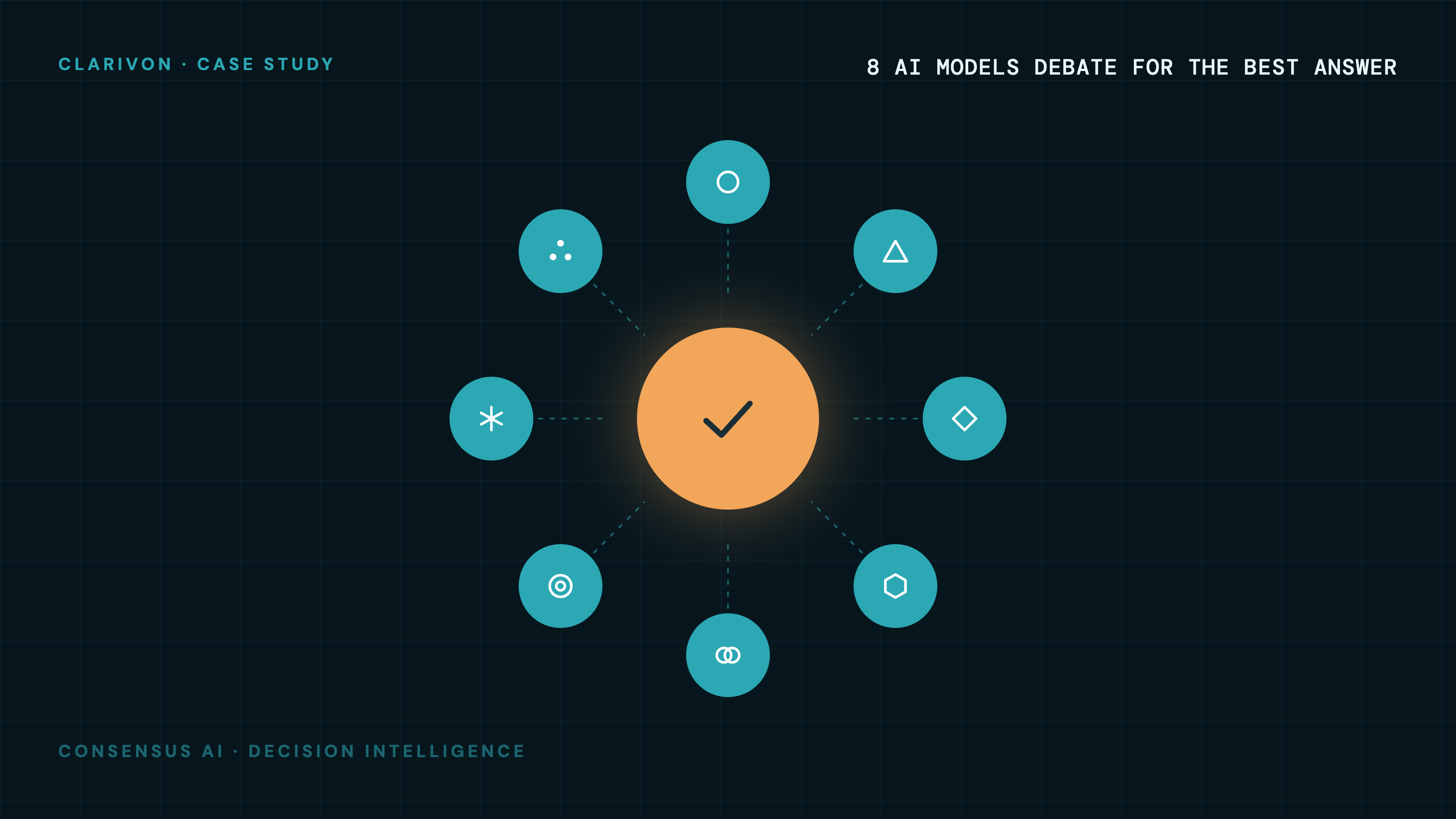
Built Consensus AI, a decision-intelligence platform that runs a question through eight leading models and has them debate, evaluate one another, and synthesize the strongest answer, instead of trusting a single black box.
The Challenge
Generative AI is powerful, but any individual model can produce incomplete, biased, or confidently incorrect answers. For higher-stakes questions, relying on a single model creates an obvious problem: how do you know whether the answer is actually the strongest one available? The opportunity was to design an AI experience that treated disagreement between models as useful information rather than noise.
Our Approach
Consensus AI was designed as a multi-model decision-intelligence platform that brings leading AI models into the same workflow, including ChatGPT, Claude, Gemini, Grok, Perplexity, Llama, DeepSeek, and OpenAI reasoning models. Rather than simply displaying multiple answers, the platform was built around three ways of working: • Auto routes a question to the model best suited to the task. • Compare lets users evaluate responses from multiple models side by side. • Debate has models independently answer the question, evaluate one another on accuracy, logic, completeness, and clarity, and then synthesize the strongest reasoning into a final response. Models do not score their own answers, reducing the risk of self-preference influencing the result.
The Result
The result is a working AI consensus engine that turns multiple competing model outputs into a structured decision process. It combines model orchestration, evaluation logic, peer scoring, synthesis, and an interface that makes sophisticated AI workflows accessible without requiring the user to understand the underlying technical architecture. Consensus AI demonstrates a different way to deploy generative AI: not asking users to trust one black box, but creating a system where models challenge one another before an answer reaches the user. The project demonstrates applied expertise in AI product strategy, multi-model orchestration, evaluation frameworks, human-centered product design, and translating emerging AI capabilities into practical decision tools.